
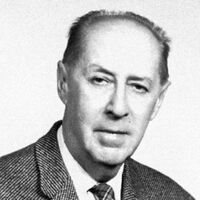
Grosschmid Sándor Károly Henrik (Kassa, 1900. április 11. – San Diego, Kalifornia, 1989. február 21.) magyar író, költő, újságíró.
English202 Magyar982 Română220You'd be wise to eat a grated apple or two every morning, when you wake up and before a meal, on an empty stomach. Apples are a mysterious fruit. It is no coincidence that it is one of the oldest symbols in the consciousness of mankind. The apple tree was the "tree of knowledge", the apple was the forbidden fruit of the Bible. Well, this forbidden fruit has a personal connection with man. Perhaps it played a role when man was cast out of Paradise; we don't know for sure. But I've noticed that raw, grated apples are a sure thing in everyday life hygiene. It is refreshing, soothes the stomach, and regulates the bowels. Especially if you wash the apple carefully with clean hands before grating and then sprinkle it with lemon juice. Longevity is not guaranteed by this gentle nutrient, but your stomach and intestines will gratefully accept this daily gift of pure, healing power. And a man is a man not only with his heart and mind but also with his stomach and intestines.
There is no age in the life of advanced, social humanity when its most distinguished poets and thinkers have not scolded the office and the bureaucrat. Only the nomadic man and the horde have not known this complaint. Groups of men mingled together in society, cannot do without this necessary evil, the office: Cicero scolds it as much as Shakespeare or Montesquieu, and no age can do without it. In the beginning, there is a square, the agora, where men from their nomadic life come together to discuss common human tasks; around the square, the city, the polis, is built; around the city, by pathological and natural procreation, the state is built. This process repeats itself for millennia at a unison pace. The official is the consequence of society, the office is the condition for the functioning of the city. No one has yet invented a substitute or a better one.
And the office has always been bad and always overbearing; think of it when you queue up in front of a cashier's office to pay your taxes after a polite and humble wait, or to save something that is yours by right and by law. The purpose of the office is not to be "good". Its purpose is not human, but public. The best official and the most perfect office is the one which does not interfere too much with life. One who does not act too much. If they make a deal with each other, life and office, they make about fifty percent deal and do not hurt each other too much: that is the most. But only very advanced, over-mature, mostly moribund societies and offices can do that.
And because we are mortal - the greatest gift of human life is that we see this fact more simply and understand it more perfectly every day - we must order our ordinary lives as one who lives in readiness. Like Seneca, when Nero reigns in the Urbs*; like the ladies and gentlemen in the cellars of the Conciérgerie**; like all men who live in revolution. Because life is a revolution. Sometimes it is especially so; for example, in the age we are now living, when the masses have taken the lead.
Therefore we must live à jour (up to date). To respond to the world every day, in a letter, a feeling or a thought. The doubt which arises in our common day, to look at it at once; to answer the question, if possible, with all our strength; to work out and complete the due phase of our task. Nature, too, lives à jour; every day, she processes, settles, finishes, and puts everything in its place.
* - The City, Rome
** - Paris prison, from where prisoners were taken to the scaffold during the French Revolution
The intellectual creative worker needs exactly the same coaching methods, training, health, and exercise regimen as the champion fencer, the show rider, or the powerlifter. You cannot make a trip in seconds from a dull, sordid, unclean lifestyle to the highest human endeavor, the arena of creative spiritual work.
The way of life, the simple and everyday conduct of life, the diet, the environment, the daily routine, all these things determine the quality of a poem or a study.
You cannot talk to God from five to five thirty in the afternoon if you have lived like a pig during the night and day. A greedy, avaricious, or mean lifestyle throws waste into the sea of your work. Constant exercise is necessary to think, and to create you need something else too.
Smart people always wear me down and exhaust me. In their company, I felt like I was taking some kind of bad-faith exam. I had to watch them forever because they were watching me, from under their narrowed eyelashes, like a hunter watching the game, to see if I was responding correctly to their clever remarks, if I was clever enough for them, the clever ones, to talk to me. No, the clever ones always tire me. And I never learned anything of substance from them. Mostly they just explained why something was not good: life, the work of a man, spring or autumn? But that life is good, death is natural, man is not quite hopeless, they never said; for they were clever.
Cleverness is not wisdom. Smartness is a skill, the agility of the nervous system, and intellect. Wisdom is truth, reassurance, forbearance, objectivity, and acquiescence. Clever men are never wise, they are too excited for that, they are as it were constantly intoxicated with their cleverness; but wise men are always clever, and at the same time more than clever, because they do not want to prove anything. Avoid the company of the wise, for they excite you and eventually offend you. Seek the company of the wise. You can talk to the clever ones. The wise ones can be listened to.
One day a voice speaks. You're doing something, or something is keeping you busy: a task that you think is of paramount importance and is your duty, your responsibility. You are already prepared for this task, you are eager to do your work. And suddenly a voice says: "Your work is different." And the possibility of a task you've never thought of before flashes before you. And you know this task will not be without danger for you. It will divert you from the direction of your work, it will require extraordinary effort, and it will provoke a series of misunderstandings, disputes, and dangers. And yet, you must leave everything behind. Your practical interests are seriously threatened by this new task. And yet, you must put everything aside, you must take on this danger, this effort, this sacrifice, this new job, this new task, this new mission, which is both implied and incomprehensible. The voice of command cannot be misunderstood. He who hears well and obeys may fall among the worldly dangers evoked by the task, but he will save his soul. He who is deaf, comfortable, or cowardly, walks comfortably on in life, but his soul remains wounded, unsatisfied, and restless. Choose, my friend.
There are two types of laziness: horizontal and vertical. There is the man who is lazy only in the long view of his life; in his plans; in postponing his resolutions, his decisions; in building up his life's work lazily, building everything into time, into the great distance. And then there is the other, vertical laziness when we remain lazy before the moment when we do not think, say or do what could be done at that moment. We don't reach out for something we could get, without much effort, and later perhaps only at great sacrifice, we don't pick up the phone, write that letter, or jot down that thought, right then, in that moment. It's the latter kind of laziness that is most dangerous. Life depends on such missed, lazily neglected moments.
Are you smug and proud to think that you have read and understood a few books, enriched your knowledge, and learned something about nature or the human spirit? Do you feel "educated", better than the ignorant? Think of the infinite mass of knowledge contained in the sum total of books, and what more would you need to know and read to fully understand a single book? Think of the iron racks that run around the library of the British Museum, how long you would have to live to know something of the material of thought which the books piled up there enclose! But stay in your library, and confess how many books you have not read among those that line your bookshelves, and how many, even among those you have read, you have fully understood and followed with all attention. No, "education", when it comes face to face with the universe of the human spirit, is a barren and vain attitude. Think rather that to understand, to grasp, to feel a single piece of knowledge, demands the fullness of life's efforts. And think, too, how much has been written and thought before you, what oceans of thought rest in the past, and with what a rush of fall in every new age the wealth of human thought flows from the sum of appearances and phenomena. Think of this, and you will be ashamed. Thy brain is finite and childish. But the culture of your character and heart may be full and worthy of man, even if your intellectual knowledge is limited.
I, for example, although I was already a grown man, got into swimming and tennis. I particularly took a liking to tennis when I was in my forties; it is the only humanistic sport; man against man, with all the strength one can muster, but there is always a distance between the combatants, they do not touch. Just as Luther never saw Erasmus, with whom he dueled for a lifetime. And swimming, how good it was, especially in the sea! To swim for a long time, in the deaf, solid water, as if one were returning home to the primordial elements of existence! However, I found these exercises distracted me from my work. They are pleasant for my body, but not good for my soul. And what is not good for my work and my soul is ultimately not good for my body. Therefore I have reduced these pleasures, and in all this, there has been much vanity; to keep young and healthy!... But it is not my business to be young and healthy, nay, not even my business to keep myself free from disease. There is only one thing for a man destined for spiritual work: spiritual work. Perhaps walking is the only kind of exercise we can afford; like prisoners who circle the prison yard for an hour a day. Work is the greatest bondage.
But exactly like the songs sung by the chanson singers in the café. And the lesson of the songs is always that broken hearts can never be glued together again. That's the lesson in life, too. Once a person has approached someone with trust, with unconditional feelings, and his feelings have been hurt, his "heart has been broken", and he can never again feel true trust, or unconditional devotion for another person. There is no more sensitive substance on earth than the human substance. He is incapable of forgetting an insult to his soul or feelings. And whatever friendship or love-meetings life may bring him, he will remain suspicious, every relationship will be a distorted and evil plaything, forever seeking revenge. That is the man. Beware when you are confronted with such wounded hearts: you cannot make amends with them. And there is not that patience, wisdom, generosity, or passion, which can soothe such disappointed hearts.
At the bottom of things is sex. Maybe even in the lives of crystals. But all sexuality is sad.
Look at the business of bodies as a judgment. Only tenderness is human. Passion is inhuman and hopeless.
But the judgment that condemns all living to passion is merciless. Between desire and gratification, the living world is built, with a will as inhuman as the Pharaohs built the pyramids with naked masses.
What do you hope for, poor naked slave, when the sharp whip of lust cracks on your back?
Happiness? Satisfaction?
You build the world's edifice, with the binder of your blood and semen, you do force labor. Only delicacy and tenderness can momentarily forget the sad constraint of the cruel bondage of sex.
Happiness, of course, does not exist in the distillable, packageable, labelable sense that most people imagine. It's like going to a pharmacy, where they give you, for three sixty, a medicine, and then nothing hurts anymore. It's like having a man for a woman, or a woman for a man, living somewhere, and once they meet, no more misunderstanding, no more selfishness, no more anger, just eternal serenity, constant contentment, cheerfulness, and health. As if happiness were anything other than a desire for the unattainable!
Most people spend a lifetime preparing for happiness methodically, sweatily, diligently, and tirelessly. They make plans to be happy, they travel and toil to that end, and they gather the requisites of happiness with the diligence of the ant and the predatory greed of the tiger. And when life has passed, they learn that it is not enough to have all the requisites of happiness. You have to be happy, too, in the process. And they forgot that.
Reason is not enough to understand oneself or the phenomena of the world: to understand and perceive the essential, the infallible, something more is needed, more than reason. It also requires grace, humility, some particularly fortunate operation of our bodies and instincts, some favorable disposition of the object of our study, and perhaps the right constellations of the stars, to understand anything on this earth. Think of this when you are proud because you think you understand this or that.
When the holiday arrives in your life, celebrate all the way. Wear black. Brush your hair with a wet brush. Clean inside and out. Forget everything that is the ritual and duty of ordinary days. The holiday is not only written in red letters on the calendar. Look at the people of the olden days, how devoutly, how unconditionally, how circumstantially, how much wild joy they celebrated! The feast of distinction. The holiday is a profound and magical unconventionality. Let the feast be festive. Let it have dancing, flowers, young women, choice dishes, and blood-sparkling drinks providing oblivion. And above all, let there be something of the old order, of the seventh day, of the interruption, of the total shutdown, let there be reverence and unalloyed. The holiday is the rank, the higher meaning of life. Prepare for it, in body and soul.
And it's not just the calendar that has a red-letter day. Life also brings other kinds of invisible holidays. Forget everything and focus on the holiday.
The greatest heroism is to stick to your job, no matter what the world says. And even more truly heroic is to destroy your work if you feel you have failed to do perfectly what you contracted yourself to do. Live between the two intentions, don't talk about it, live fully to your task, and remain ruthless to your work. It takes strength not only to create; it takes strength to judge your work. Remain harsher on your work than the world can ever be.
If there is a rule of life in our lives, we must adhere to it at all costs; for the life of a grown man is made up of rules and ways of life like a building of solidly assembled bricks, and it is not advisable to shake this structure by moving one or another brick out of place. Beyond forty years, our lives will be filled with rules that others may regard as rigid: we know that their real purpose is to defend against anarchy. Waking up, going to bed, entertainment, working hours, relationships with people, all of these are governed by strict laws over time.
And if we break these laws, our consciences are filled with guilt. It is not true that a lifestyle can be "spontaneous". You yourself may be spontaneous at times, your decisions, your passions, and your ideas may be voluntary: but your way of life, independent of all that, cannot be voluntary and idea-like. If people don't like you living in one way or another, in a different way from the way they would like, imagine, or in a different way from the way you once, by some necessity or misunderstanding, promised them: don't mind. You do not live for the people. But if you sin against your own laws, you will bitterly regret this disloyalty. Even in your sins and faults, keep the system that follows from the laws of your life. In the eyes of the world, you may fail at any time. We must not be weak before ourselves; for that is the true fall.
Fight fanaticism always, everywhere, in every way and at every opportunity. Against the foaming-at-the-mouth, whining impulse that bursts out of its human hiding place and wants to carve up and shape the world. To fight fanaticism with patience, with explanation, with reason, with consistent pedagogy. And also with compassion. Pity the fanatic. He lashes out at you, but in the frenzy of the attack, he bites his own tongue and crushes himself.
If someone doesn't arrive at the meeting at the agreed time - be it a man or a woman, a friend or a stranger - you can wait fifteen minutes. Then leave. And if you cannot excuse yourself with a legitimate excuse, do not seek the company of such a person again. Keep no anger or resentment in your heart, for it is unworthy of a man. But give no more occasion to the other to keep you waiting. People insult each other out of meanness and cowardice. Making people wait is such an arrogant insult.
In all, everything you do, be precise to the second. You cannot be so tired, so sad, or so listless, as to sin against the law of polite punctuality. Punctuality is not only the courtesy of kings, but the duty of all responsible men of rank. He is a man of first rank who is punctual without interest. The sluggard, the slothful, the frivolous man is always late. Such a man is, after all, late for the great meeting of life: the meeting of self-knowledge.
Waiting, with the patience of an angel and a saint, until the things - people, ideas, situations - that belong to you come to you. Not to hurry a single step towards them, not to hurry their approach with a single movement or word. For certain people, ideas, and situations, that belong to your life, your character, and your worldly and spiritual destiny, are constantly on their way toward you. Books. Men. Women. Friendships. Insights, truths. It's all coming your way, in a slow trickle, and you must meet one day. But you must not hurry, do not hurry their journey and their approach. If you are in too great a hurry, you may miss what is important and personal to you. Wait, with great strength, attentively, with your whole destiny and life.
In the terrible race of life, most people only rest when they are sick. Sickness, in the words of the French poet, is not only the journey of the poor but also the holiday of the poor, the winter Riviera, the Tatras, and Egypt. To feverish spirits, illness sends a real fever to calm them down a little. The ambitious and insatiable man on the run, who, like the poet Kleist, 'changes cities like a fever-patient changes pillows', only recalls his true desires and hopeless passions in his sickbed.
Illness is also rest, it is a cliché. Therefore, anticipate nature's command, the forced sick leave, and add small, artificial illnesses to the rhythm of your life to rest. Keep your bed in good health for a day at a time. Thou hast a wolf's appetite, thou wouldst chew the nail: fast a day or two voluntarily. Your heart isn't nagging you about nicotine yet: reward it by giving up cigarettes for three days without a compelling need. Your body is so grateful for the slightest attention! And these tiny, artificial states of illness and recovery, voluntary diets, withdrawals, and rests, recalled without the command of the disease, are the equivalent of an Oriental trip or an appendectomy. Try it. You will see miracles.
There is a kind of man who laughs only with his mouth. They are like paralytics; like people who are deaf or have no sense of smell. You joke in their presence, you make your point in some distorted or amusing situation in life, and you are shocked to find that he does not understand or hear exactly what is so funny in this little casual story: he laughs, but he laughs with his mouth. His heart and mind failed to see the profoundly phony ridiculousness of the situation. He laughs politely, gritting his teeth. But his heart never laughs. These grim grins can be fearful. Don't joke with them. When you point to life, their response is to show their fangs.
Never see the struggle between man and woman as anything other than a hopeless struggle, fuelled by the cruelest selfishness and unbridled vanity. Let not the bribing moments, the gentler situations of life, the occasional indulgences, when you face a woman, ever make you forget that you are a warrior whose skin and life the adversary wants. Fight gallantly, but fight. If you meet with generosity sometimes, repay with generosity; if you meet with tenderness, return, without sentiment, with tenderness what you have received; if you meet with passion, respond with unconditional passion. But never, for one moment, forget that at the bottom of every emotional encounter smolders naked selfishness and vanity. He who lies in a woman's bed lies on ember. His skin may be burnt; his human rank and honor must be saved. Watch and fight. Opponents stand around, feathers in their hair, paint on their faces, like fierce warriors.
No human relationship is more poignant and deeper than friendship. In the relationship between lovers, yes, even between parents and children, how much selfishness and vanity! Only a friend is not selfish; otherwise, he is not a friend. Only a friend is not vain, because he wants all that is good and beautiful for his friend, not for himself. The lover always wants something; the friend wants nothing for himself. A child always wants to receive from his parents, to outshine his father; a friend neither wants to receive nor to outdo. There is no more secret and noble gift in life than friendship, which is unassuming, understanding, patient, and sacrificial. And there is none rarer.
Montaigne, reflecting on the feeling that had drawn him to La Boétie, said, "We were friends... Because he was he, and because I was I." This is more than accurate. And Seneca writes to Lucilius: "A friend loves, but a lover is not always a friend." This statement is more than accuracy: it is truth. All love is suspect because selfishness and miserliness lurk in its ashes. Only the affection of a friend is unselfish, without interest or the play of the senses. Friendship is a service, a strong and serious service, the greatest human test and role.
Take care never to rush, and in your work, in your social life, and yes, in your everyday actions, to obey the strict consistency of facts and situations. Do not try to do two things with two hands at the same moment. When writing a letter, do not listen to the telephone receiver. When you smoke, don't try to cure your tracheitis at the same time. When you read, don't listen to music. Above all: pay attention to the deep order of tasks and situations. There's dexterity at the bottom of human tasks; it's not a bad thing to learn. If you hold something, hold it with both hands and firmly; if you let go of something, let it go consciously and with all consequences; if you speak, let your word stand in time like a stone; if you are happy about something, be happy without reservation. There is a craft in life, and there is a craft in the common days. And Mondays have their unskilled. Watch your movements. The cause of most human misfortunes is not Greek misfortune, but clumsiness, idleness, and sloth. Learn this craft, this life, and remain the master of life in motion and action.
There are incurably wounded people who are so deeply infected by greed, vanity, and envy that there is no way to reach out and atone for their sick souls. Pity these, but avoid them. No generous act, unselfish conduct, or courageous and noble approach can help these people. Envy especially torments these people. They vomit bile, they cry out in their sleep, they toss and turn in their dens like epileptics, and they spit up foam when they see that someone has earned or achieved something in life through work or the benevolence of a gracious fate. They are sick, infectious sick. Avoid their company, don't think that argument or proof can ever convince them. It's like trying to prove to a leper that the healthy are innocent and guiltless! He doesn't believe it. If you reveal to them the real cause of their illness, they will hate you. If you try to appeal to their feelings, they'll grab a stick. They live in their passions as deeply as the fate of the exile: they know no other way but revenge. Do not bargain with them, avoid them, and bear their existence on earth as a blow of fate.
Wherever you escape to, work, role, or behavior, people won't let you go, they'll chase you, demand you participate in their movements, share their concerns, plans, and hopes, tug at your coat-tails, and attack and disown you if you retreat from common tasks. You must settle down - and if you are an artist, a thinking, contemplative person, it is not easy! - that you have to go with the people. You have to cry and laugh with them, and you can only be happy and content if they let you.
But people, you say, are only responsible, sentient, and participating people individually; in a crowd, they are like a herd; the cheapest slogans fire them, and the basest desires strain the chest of the crowd. How can I take part in their affairs if I do not want my soul to be harmed?
I can only answer: preserve the liberty of your soul by remaining just. When the mob desires of thee what thy conscience denies, deny their desire. Whatever the cost or consequence of such conduct. The limit of your solidarity is justice. You too have a law and a power, not only they. This law and power is justice: they can break your head, but they cannot take this power away from you.
For five thousand years, for ten thousand years, human matter has not changed. Only the costumes have changed, the systems and conditions of coexistence haven't changed. What is human - the soul and character - has not changed. In the city of Ur, Babylon, the same people lived as in Budapest today: and in their souls, they perceived the world and responded to the world in exactly the same way. Only, without instruments, they were closer to the secrets of the world, to time, to the stars, to the sign language of nature. Their hearing was more subtle, their vision - even without binoculars - sharper, more perceptive, more intuitive, more gripping. The human substance has not changed, but man is - thanks to a few geniuses and instruments - more blind and deaf in civilization than he was at the beginning of human times. Duller and dumber. More intelligent and at the same time more ignorant. He thinks he controls the universe with the push of a button. This vast structure, civilization, has banished man from the great, secret, intimate community of the world.
I've experienced that raw carrots, finely grated and sprinkled with lemon juice, are not only a refreshing food but also calm the nerves, especially the nerves in the eyes. I have heard - but I have not personally experienced this - that one of the components of raw carrots, carotene, definitely strengthens the optic nerves and sometimes prevents blindness and clears incipient cataracts. This is possible, but not certain. What is certain is that raw, grated carrots, sprinkled with lemon juice and eaten with a meal or instead of a salad, are invigorating, refreshing, beneficial, and healing. It is also certain that it does no harm. In the same way, I can recommend unpeeled apples - one every day when it's the season - and a generous consumption of lemon and orange juice. I have noticed that in years when I have eaten plenty of raw carrots, lemon, and orange juice every day at the end of winter, I have not had colds or infectious diseases.
One day everything will have to be accounted for. But everything. It is inevitable. And however you think: what you've done wrong, what you owe, what you've been cowardly, what you've been guilty of, you'll give an account for it all one day. Strengthen therefore your soul always: for you are not without sin. And if I am burned at the stake, know that I am innocent, but I am also guilty. And give an account of thyself willingly, before they demand it: thou doest wisely, and men will esteem thee better if thou doest so. Do not delay the reckoning. What can you hope for? You are a man, therefore you are guilty.
Travel light. Travel, but know at every moment that there is nowhere for the passenger to really stay. Don't spend a lot of time sorting your luggage, and don't carry unnecessary items on your travels. Packing ages you.
It's the small, incidental tasks of life that age you most. The fiddling around, the unnecessary complications of daily rituals, the annoyance of buttons falling off, the worry of mail not being sent on time, packing on the road. You don't just age dramatically, with waving white curls and calcified veins, no. You also age prematurely if your laundry doesn't fit in your hamper after a week, even though it fit splendidly in its ironed state a week ago. Travel light, like the birds. You'll go farther and stay young.